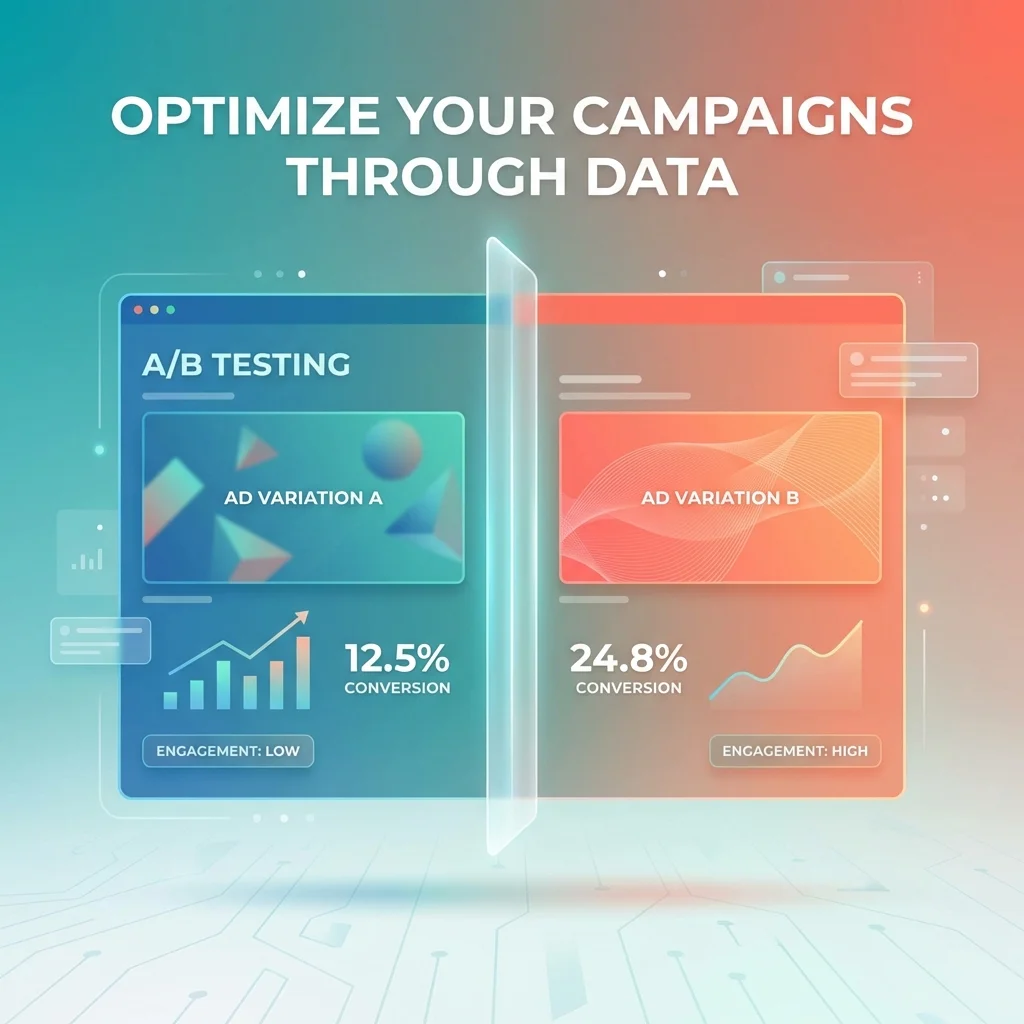
The Complete A/B Testing Guide for Small Business Ads
Here's a frustrating truth: that ad you spent hours perfecting might perform worse than a version you created in 5 minutes.
The only way to know what actually works? Testing.
But A/B testing often feels like something only big companies with dedicated analytics teams can do properly. Marketing blogs will tell you about statistical significance and sample sizes, and suddenly it all seems too complicated.
It doesn't have to be. Let's break down A/B testing for small businesses with real budgets and real constraints.
What A/B Testing Actually Means
At its core, A/B testing is simple: show Version A to some people, show Version B to others, and measure which one performs better.
That's it. Everything else is just refinement of this basic concept.
For ads specifically, you might test:
- Headlines — "50% Off Valentine's Sale" vs "Love Your Savings This Valentine's"
- Images — Product on white background vs lifestyle shot
- CTAs — "Shop Now" vs "Get The Deal" vs "See Collection"
- Colors — Red button vs green button
- Offers — "Free Shipping" vs "10% Off"
The goal is to stop guessing and start knowing.
Why Small Businesses Actually Have an Advantage
Counterintuitive take: small businesses can often A/B test more effectively than large corporations.
Here's why:
Faster Decision Making
In large companies, changing an ad requires approval from three managers, legal review, and a committee meeting. You can decide right now.
Lower Stakes Per Test
If a test ad underperforms for a day, you're not losing lakhs. This means you can test bolder variations without fear.
Direct Customer Connection
You know your customers personally. When results come in, you have context that helps you understand why something worked.
Agility
You can test and implement changes in the same day. Big companies take weeks to roll out what you can do in hours.
The Practical A/B Testing Framework
Forget complicated statistical formulas. Here's a practical framework that works for small budgets:
Step 1: Pick ONE Variable
This is the most common mistake. People test:
- New headline + new image + new color + new CTA
If this version performs better, what made the difference? You have no idea.
Rule: Change one thing at a time. If you're testing headlines, keep everything else identical.
Step 2: Create Meaningful Differences
Don't test "Shop Now" vs "Shop Today". These are too similar to produce useful data.
Test "Shop Now" vs "Claim Your 20% Discount" — fundamentally different approaches that will produce a clear winner.
Good test variations differ in:
- Approach (urgency vs value vs curiosity)
- Tone (formal vs casual)
- Focus (product vs benefit vs emotion)
Step 3: Define Your Success Metric
Before you run the test, decide what "winning" means:
- Click-through rate?
- Conversion rate?
- Cost per acquisition?
- Return on ad spend?
Different metrics can give different winners. An ad with high clicks but low conversions isn't actually better than one with fewer clicks but more sales.
Step 4: Run for Adequate Duration
The minimum viable test depends on your traffic:
| Daily Ad Views | Minimum Test Duration |
|---|---|
| 100-500 | 7-14 days |
| 500-2000 | 3-7 days |
| 2000+ | 2-3 days |
Note: These are rough guidelines. Less traffic means longer tests.
Step 5: Wait for Clear Winners
Don't declare a winner after 10 clicks. The more data, the more confident you can be.
Quick and dirty rule: If Version A has had 100+ views and is performing 20%+ better than Version B, you probably have a winner. If it's a 5% difference, keep testing longer.
What to A/B Test First (Priority Order)
If you're new to A/B testing, here's where to start:
1. Offer/Value Proposition
This has the biggest impact. Test different offers:
- "Free Shipping over ₹999" vs "10% Off First Order"
- "Buy 2 Get 1 Free" vs "Flat 30% Off"
2. Images
Visual content drives engagement. Test:
- Product photography vs lifestyle photography
- Single product vs product collection
- Close-up vs full product shot
3. Headlines
Your primary text hook. Test:
- Question vs statement
- Benefit-focused vs feature-focused
- Urgency vs value
4. Call-to-Action
Often overlooked but surprisingly impactful. Test:
- Action verbs: "Shop" vs "Discover" vs "Get"
- Specificity: "Shop Now" vs "Shop Kurtas" vs "Shop The Collection"
5. Colors and Design Elements
Save these for last—they matter, but less than message and offer.
Practical Examples
Let's make this concrete:
Example 1: A Café Testing a Weekend Offer
Test: Different framing of the same offer
Version A: "Weekend Special: 20% Off Breakfast Combos" Version B: "This Weekend Only: ₹149 Breakfast Combos (₹199 Value)"
Result: Version B gets 34% more clicks. Why? Specific pricing is more tangible than percentages.
Takeaway: When possible, show real rupee values rather than percentages.
Example 2: A Clothing Brand Testing Images
Test: Product styling approach
Version A: Kurta on white background with measurements Version B: Model wearing kurta in natural setting
Result: Version B gets 23% more clicks AND 15% higher conversion rate.
Takeaway: Lifestyle imagery helps customers imagine themselves wearing the product.
Example 3: A Home Baker Testing CTAs
Test: Action framing
Version A: "Order Now" Version B: "Order Fresh for Tomorrow"
Result: Version B wins by 42%.
Takeaway: Adding specificity (freshness, delivery timing) can significantly impact response.
Common A/B Testing Mistakes
Testing Too Many Things
We mentioned this, but it's worth repeating. Each additional variable multiplies complexity. Stick to one variable per test.
Stopping Too Early
"Version A is winning after 2 hours!" That's noise, not signal. Early results often flip completely by the end of the test period.
Ignoring Seasonality
An ad that performs well on Monday might perform differently on Saturday. Run tests across multiple days to account for variation.
Not Acting on Results
The whole point of testing is to apply what you learn. If Version B wins, update your other ads to use that approach.
Forgetting to Document
Keep a simple log:
- What you tested
- Results
- What you learned
This prevents you from re-running the same tests and builds organizational knowledge.
A/B Testing with Limited Budgets
If you're spending ₹3-5k per month on ads, you might think A/B testing is impractical. Here's how to adapt:
Use Organic Posts as Tests
Before paying for ads, post two versions of content organically. The one that gets more engagement becomes your ad creative.
Test Headlines in WhatsApp Status
Want to test two promotional headlines? Post them at different times and see which gets more responses.
Sequential Testing
Can't run A/B tests simultaneously? Run Version A for a week, then Version B for a week, and compare. Not perfect, but better than nothing.
Leverage AI for Volume
Tools like Avocad let you generate multiple ad variations quickly. Instead of spending hours creating two versions, generate five variations and test the most different ones.
Building a Testing Culture
The most valuable outcome of A/B testing isn't any individual result—it's developing an evidence-based approach to marketing.
Over time, you'll:
- Stop having opinions about what works (you'll have data)
- Build intuition backed by real results
- Make faster, more confident decisions
- Waste less money on underperforming ads
Start small. Run one test this month. Look at the results. Apply what you learn.
That's it. You're now A/B testing.
Quick Start Checklist
Ready to run your first A/B test? Here's your checklist:
- [ ] Pick one variable to test (headline, image, or CTA)
- [ ] Create two meaningfully different versions
- [ ] Define your success metric before starting
- [ ] Set up tracking (platform analytics is fine)
- [ ] Run for minimum 3-7 days
- [ ] Document the winner and why you think it won
- [ ] Apply the learning to other ads
Running interesting A/B tests? We'd love to see your results. Share them with us at avocad.xyz, and we might feature your case study in a future post.
— The Avocad Team