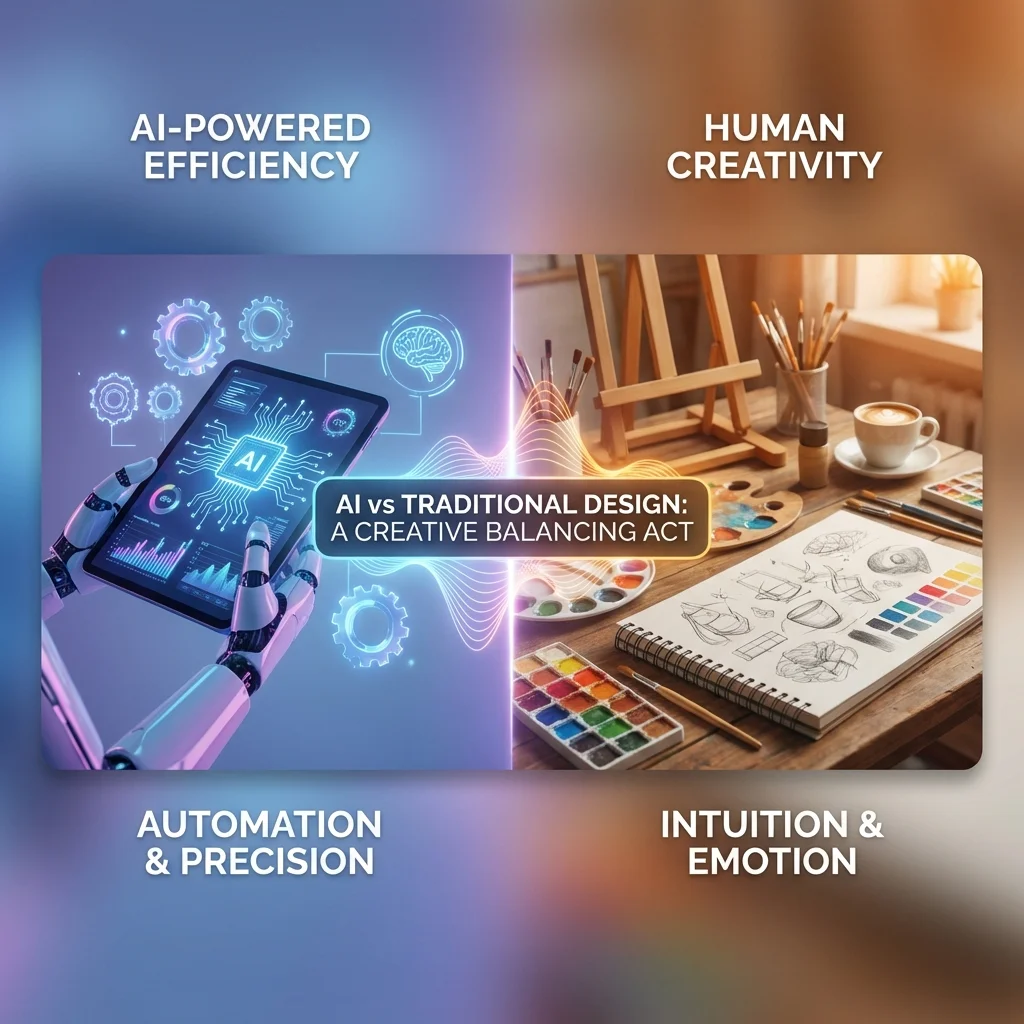
AI vs Traditional Design: Choosing the Right Tool for Your Needs
The rise of AI design tools has sparked a familiar debate: will AI replace designers?
This is the wrong question.
The better question is: when should you use AI, when should you use traditional design approaches, and how can you combine both effectively?
Let's dive into an honest comparison that acknowledges both the genuine capabilities of AI and the irreplaceable value of human creativity.
Defining Our Terms
Before comparing, let's be clear about what we're discussing:
AI Design Tools
Software that uses artificial intelligence to generate or assist with visual design. This includes:
- Image generators: Midjourney, DALL-E, Imagen
- Design assistants: Canva Magic Design, Adobe Firefly
- Specialized tools: Avocad (ad-focused), Looka (logo-focused)
- Enhancement tools: AI-powered upscaling, background removal
Traditional Design
Human designers creating visual work using professional tools:
- Freelance designers: Hired per project
- In-house designers: Full-time team members
- Design agencies: Teams offering comprehensive services
- DIY with pro tools: Adobe Creative Suite, Figma, etc.
The Honest Comparison Matrix
Let's compare across key factors:
Speed
| Factor | AI Tools | Traditional Design |
|---|---|---|
| First draft | Minutes | Hours to days |
| Variations | Seconds | Hours (per variation) |
| Revisions | Seconds | Hours (depending on complexity) |
| Campaign volume | Unlimited at speed | Limited by human capacity |
Winner: AI, clearly. A task that takes AI 30 seconds might take a human designer 30 minutes.
But: Speed isn't everything. Fast garbage is still garbage.
Quality Ceiling
| Factor | AI Tools | Traditional Design |
|---|---|---|
| Competent execution | High | High |
| Uniqueness | Medium | Very High |
| Refinement | Good | Excellent |
| Breakthrough creativity | Low | High |
Winner: Traditional design for peak quality.
But: Most businesses don't need breakthrough creativity for every piece. They need consistent, good-enough quality at scale.
Cost
| Scenario | AI Tools | Traditional Design |
|---|---|---|
| 1 ad creative | ₹0-100 | ₹1,500-10,000 |
| 10 ad variations | ₹0-200 | ₹10,000-50,000 |
| Monthly social content (30 posts) | ₹500-2,000 | ₹30,000-150,000 |
| Full rebrand | Limited capability | ₹100,000-500,000+ |
Winner: Depends on volume. AI for high volume, traditional for strategic work.
The math: If you're creating 50+ pieces of content monthly, AI dramatically changes the economics.
Brand Consistency
| Factor | AI Tools | Traditional Design |
|---|---|---|
| Following brand guidelines | Good (if trained) | Excellent |
| Maintaining voice/feel | Medium | Excellent |
| Adapting to context | Limited | Excellent |
| Evolving the brand | Poor | Excellent |
Winner: Traditional design for brand stewardship.
But: AI tools are improving. Systems that learn your brand (like Avocad's Brand DNA extraction) are closing the gap for routine work.
Scalability
| Factor | AI Tools | Traditional Design |
|---|---|---|
| Handle volume spikes | Unlimited | Constrained by team size |
| 24/7 availability | Yes | No (without global teams) |
| Consistent output during scale | Yes | Quality often drops at volume |
| Multi-market adaptation | Strong | Requires resources |
Winner: AI for scalability.
Real talk: This is where AI shines most. When you need 50 variations for A/B testing or 20 market localizations, AI handles what would be prohibitively expensive with humans.
When AI Design Is the Right Choice
AI tools make sense when:
1. Volume is High, Stakes are Medium
Social media content, ad variations, email graphics—these need to be good but don't need to be perfect. AI excels here.
Example: A restaurant posting daily specials on Instagram. AI can generate consistently branded posts at a fraction of the cost of a designer.
2. Speed is Critical
Sales ending in 2 hours? Need flash sale graphics now? AI doesn't need lead time.
Example: An e-commerce store reacting to a trending moment. AI can create response content while the moment is still hot.
3. Budget is Limited
If professional design isn't affordable, AI democratizes access to decent quality.
Example: A solo founder bootstrapping a startup. AI gives them professional-looking collateral without the professional price tag.
4. Testing is the Goal
Creating 10 headline variations to A/B test? AI makes testing economically viable.
Example: A performance marketing team testing ad variations. AI generates options in minutes, letting data pick winners.
5. The Work is Template-Based
Repetitive work following established patterns is perfect for AI.
Example: Monthly reports that follow the same format. AI can populate templates faster and cheaper.
When Traditional Design Is the Right Choice
Human designers are essential when:
1. Brand Definition is the Goal
Creating a brand identity, logo, or visual system requires human judgment and creativity.
Example: A new company defining its visual identity. This strategic, foundational work requires human expertise.
2. Emotional Resonance is Critical
Ads for sensitive topics, emotional campaigns, or high-stakes moments need human empathy.
Example: A charity campaign about social issues. AI lacks the emotional intelligence to navigate this sensitively.
3. Uniqueness is the Differentiator
Standing out from competition requires genuine creativity, not pattern-matching.
Example: A luxury brand campaign. The goal is to feel different and special, which requires human creative vision.
4. Complex Problem-Solving is Needed
Design that solves UX problems, integrates with architecture, or requires strategic thinking.
Example: App interface design. Understanding user needs, flows, and interactions requires human designers.
5. The Work Will Define You
Hero campaigns, flagship products, brand-defining moments—these warrant investment.
Example: Super Bowl ad creative. When millions are watching, invest in the best human creative minds.
The Hybrid Approach: Blending Both
The most sophisticated teams aren't choosing between AI and human designers—they're combining both effectively.
Model 1: AI for First Drafts, Humans for Refinement
AI generates initial concepts rapidly. Human designers select the best directions and refine them to professional quality.
Workflow:
- AI generates 10 options
- Team selects top 2-3 concepts
- Designer develops and polishes selected concepts
- Final output is AI-assisted but human-finished
Time saved: 50-70% Quality maintained: High
Model 2: Humans Set Strategy, AI Executes
Human designers create brand guidelines and templates. AI applies those templates at scale.
Workflow:
- Designer creates brand system and templates
- AI generates content following those templates
- Quick human review catches errors
- Content published at scale
Best for: High-volume, brand-consistent content needs
Model 3: AI for Testing, Humans for Winners
AI generates variations for testing. Winners get human optimization.
Workflow:
- AI creates multiple ad variations
- A/B test identifies winning concepts
- Designer creates polished versions of winners
- Polished versions run at scale
Advantage: Combines AI's testing speed with human's quality finishing
Model 4: Separate Lanes
AI handles routine work. Designers focus on strategic work.
Separation:
- AI: Daily social posts, ad variations, email graphics
- Humans: Brand development, hero campaigns, complex design
Advantage: Designers spend time on high-value work, AI handles the rest
The Real Cost Comparison
Let's make the economics concrete with a hypothetical small business scenario:
Scenario: Monthly Marketing Needs
- 20 social media posts
- 10 ad variations for testing
- 5 email headers
- 1 hero campaign image
| Approach | Time | Cost |
|---|---|---|
| All freelance design | 20-30 hours | ₹25,000-50,000 |
| All in-house design | Part of salary | ₹15,000-25,000 (allocated) |
| All AI (like Avocad) | 2-3 hours | ₹2,000-5,000 |
| Hybrid (AI routine + designer hero) | 8-10 hours | ₹10,000-15,000 |
Analysis: The hybrid model costs less than all-human but delivers higher quality than all-AI.
ROI Consideration
If AI-generated ads convert at 80% of the rate of human-designed ads, but cost 10% as much, they often have better ROI—especially for testing.
| Human Design | AI Design | |
|---|---|---|
| Cost per ad | ₹5,000 | ₹500 |
| Conversion rate | 2.0% | 1.6% |
| Cost per conversion (if 1000 views) | ₹250 | ₹31.25 |
In this scenario, AI is more cost-effective despite lower conversion rates.
The Human Designer's Evolving Role
AI isn't replacing designers—it's changing what designers do.
Skills Gaining Value
- AI prompting and curation: Knowing how to get good output from AI tools
- Strategic thinking: Deciding what to communicate and why
- Brand guardianship: Ensuring consistency across AI and human output
- Complex problem-solving: Work that requires genuine creativity
- Creative direction: Guiding AI tools toward desired outcomes
Skills Commoditizing
- Basic execution: Simple layouts, standard templates
- Pure production: High-volume repetitive work
- Technical tasks: Perfect cut-outs, color correction, resizing
Smart designers are leaning into strategic and creative work while using AI to handle routine execution.
Making Your Choice
So which approach is right for you? Consider:
Use primarily AI if:
- You're highly budget-constrained
- Volume is high and speed matters
- Content is routine and template-friendly
- You're in heavy testing/experimentation mode
Use primarily human design if:
- Brand building or definition is the goal
- Work is strategic or high-stakes
- Uniqueness is a competitive advantage
- Complex problem-solving is required
Use a hybrid approach if:
- You have varying needs (routine + strategic)
- Quality matters but so does volume
- You want to optimize both cost and output
- You're building long-term design capability
The Bottom Line
The AI vs. human designer debate misses the point. Both are tools with different strengths, and the best outcomes come from understanding when to use each.
AI hasn't made designers obsolete—it's made certain types of work more efficient. The question isn't which one to choose, but how to combine them for your specific situation.
For most small businesses, the sweet spot is:
- AI for volume, testing, and routine work
- Human creativity for strategic, brand-defining work
- A systematic approach to deciding which is which
The businesses that figure out this balance will have a significant advantage: they'll move faster than competitors who rely entirely on traditional design, while maintaining higher quality than those who rely entirely on AI.
Looking for AI design that stays true to your brand? Avocad analyzes your Brand DNA to create ads that look like yours, not generic templates. Try it at avocad.xyz.
— The Avocad Team