How to Create Meta Ad Creatives That Convert Step by Step
Meta platforms remain the most important advertising channel for most businesses. Facebook and Instagram combined reach over 3 billion people, including your target customers.
But the platform is crowded. Users scroll past hundreds of posts daily. Most ads get ignored.
This guide walks through the exact process for creating Meta ad creatives that stop thumbs, communicate value, and drive conversions. No theory without application. Every step is actionable.
Understanding Meta Ad Performance
Before creating, understand what Meta's algorithm rewards:
The Engagement Loop
Meta shows ads to users who are likely to engage. High engagement leads to:
- Lower cost per impression
- Better audience delivery
- More conversions at lower cost
Creatives that get engagement win on Meta.
The Three-Second Test
Users decide in under 3 seconds whether to stop or scroll. Your creative must pass two tests instantly:
- Is this relevant to me?
- Is this worth my attention?
The Scroll Environment
Meta ads appear between friends' posts, news, and entertainment content. Your ad competes for attention against content people actually want to see.
Understanding this context shapes effective creative strategy.
Step 1: Define Your Creative Goal
Different campaign goals require different creative approaches.
Awareness Creatives
Goal: Get seen and remembered Priority: Brand recognition, memorable visuals, emotional connection Call to Action: Soft (Learn More, See More)
Consideration Creatives
Goal: Generate interest and engagement Priority: Value communication, benefit clarity, curiosity creation Call to Action: Medium (Shop Now, Get Details)
Conversion Creatives
Goal: Drive immediate action Priority: Offer clarity, urgency, friction reduction Call to Action: Strong (Buy Now, Add to Cart, Order Today)
Choose your goal before starting creative development.
Step 2: Know Your Format Options
Meta offers multiple ad formats. Each suits different objectives.
Single Image Ads
Best For: Clear product focus, simple messages, broad testing Dimensions: 1080x1080 (1:1) or 1080x1350 (4:5) Considerations: One image must do all the work
Video Ads
Best For: Demonstrations, storytelling, complex products Dimensions: 1080x1080, 1080x1920 (9:16 for Stories/Reels) Considerations: First 3 seconds are critical
Carousel Ads
Best For: Multiple products, sequential storytelling, feature breakdown Dimensions: 1080x1080 per card Considerations: First card must earn the swipe
Stories and Reels Ads
Best For: Full-screen impact, native feel, younger audiences Dimensions: 1080x1920 (9:16) Considerations: Must look native, not like ads
For most testing, start with single image in 1:1 and 4:5 formats.
Step 3: Develop Your Core Message
Every effective ad communicates one clear message. Not three. Not five. One.
Message Development Framework
Answer these questions:
What problem does your product solve? Be specific. "Helps you look better" is vague. "Hides dark circles in 30 seconds" is specific.
What is the primary benefit? Not feature. Benefit. "Contains Vitamin C" is a feature. "Visibly brighter skin in 2 weeks" is a benefit.
Why should someone act now? Create reason for immediate action. Limited offer, limited stock, limited time.
What makes you different? If your product looks like every competitor, why choose you?
Message Testing
Write 10 versions of your core message. Have team members rank them. The best message becomes your creative foundation.
Step 4: Create Your Visual Hierarchy
Effective Meta creatives guide the eye deliberately.
The Visual Hierarchy Stack
Level 1: The Scroll Stopper What makes someone stop scrolling? Usually:
- Motion (for video)
- Face or eyes
- Unexpected visual
- Bright color contrast
- Clear product focus
Level 2: The Value Zone Where the benefit or offer is communicated:
- Clear headline or text overlay
- Product in context
- Before/after visual
Level 3: The Brand Anchor Your logo or brand colors, positioned to build recognition without dominating.
Practical Application
Sketch your ad before designing it. Mark where your scroll stopper, value zone, and brand anchor sit. If any is unclear, rethink the layout.
Step 5: Write Scroll-Stopping Headlines
Your headline may be the only text someone reads. Make it work independently.
Headline Formulas That Convert
The Direct Benefit "Clear Skin in 2 Weeks — Without Harsh Chemicals"
The Curiosity Hook "The Ingredient Dermatologists Keep Secret"
The Social Proof "Join 50,000 Women Who Fixed Their Skin This Month"
The Problem Agitation "Still Struggling With Dark Circles?"
The Offer Lead "50% Off This Week Only — No Code Needed"
Headlines for Indian Audiences
Consider language mixing that feels natural:
- "Ab no more skin problems"
- "Finally, kurtas that actually fit"
- "Desi ingredients, international results"
Test both English-only and mixed approaches.
Step 6: Design the Visual Elements
Now apply the strategy to actual design.
Product Image Guidelines
Use High-Quality Images Blurry or low-resolution images fail immediately. Invest in good product photography.
Show Context Product in use performs better than product alone. Show your kurta on a person, your face cream on skin.
Create Contrast Your product should visually pop from the background. Light products on dark backgrounds. Colorful products on neutral backgrounds.
Show Scale If size matters, show it. Products alone often look smaller than reality.
Text Overlay Rules
20% or Less Meta no longer penalizes text-heavy images, but they often perform worse. Keep text minimal.
Readable at Mobile Size Test at actual mobile dimensions. If text is unreadable on phone, it fails.
Contrast for Legibility Text needs background contrast or shadows to be readable over images.
Color Psychology
Red: Urgency, excitement, passion Blue: Trust, calm, professionalism Green: Natural, healthy, growth Orange: Energy, fun, impulse Black: Premium, sophisticated, luxury
Match colors to message and brand.
Step 7: Craft the Ad Copy
Meta ad copy has three components: Primary Text, Headline, and Description.
Primary Text (Above the Creative)
First Line is Everything Only 125 characters show before "See More" on mobile. Your hook must fit there.
Structure for Scanning
- Hook sentence
- Benefit expansion
- Social proof or credibility
- Clear call to action
Example "Dark circles ruining your look? Our Vitamin C serum fades them in just 2 weeks.
Tested by 10,000 customers. 4.8 star average rating.
Try it risk-free with our 30-day guarantee.
Shop now and save 20% this week."
Headline (Below Creative)
Short and direct. 5-7 words maximum.
- "Get Clear Skin Now"
- "Shop the New Collection"
- "Flat 50% Off Everything"
Description
Additional context. Often only shown on desktop or certain placements. Keep it benefit-focused and action-oriented.
Step 8: Optimize for Each Placement
Meta serves ads across multiple placements. Each needs consideration.
Feed (Facebook and Instagram)
Dimensions: 1:1 or 4:5 Key Focus: Scroll stopping visual Text Visibility: Primary text visible
Stories
Dimensions: 9:16 Key Focus: Full-screen impact, native feel Text Visibility: On the creative itself
Reels
Dimensions: 9:16 Key Focus: Video, entertainment value, fast pacing Text Visibility: On the creative
Audience Network
Dimensions: Various Key Focus: Clear offer, clickable Text Visibility: Limited
Right Column (Desktop)
Dimensions: 1:1 Key Focus: Small and clear Text Visibility: Very limited
Create dedicated versions for Stories/Reels rather than relying on auto-cropping.
Step 9: Build Your Testing Framework
One creative is not a strategy. Testing is how you find winners.
Variable Testing Approach
Test one variable at a time:
- Round 1: Test 3-5 different visual concepts
- Round 2: Test 3-5 different headlines with the winning visual
- Round 3: Test 3-5 different offers with winning visual and headline
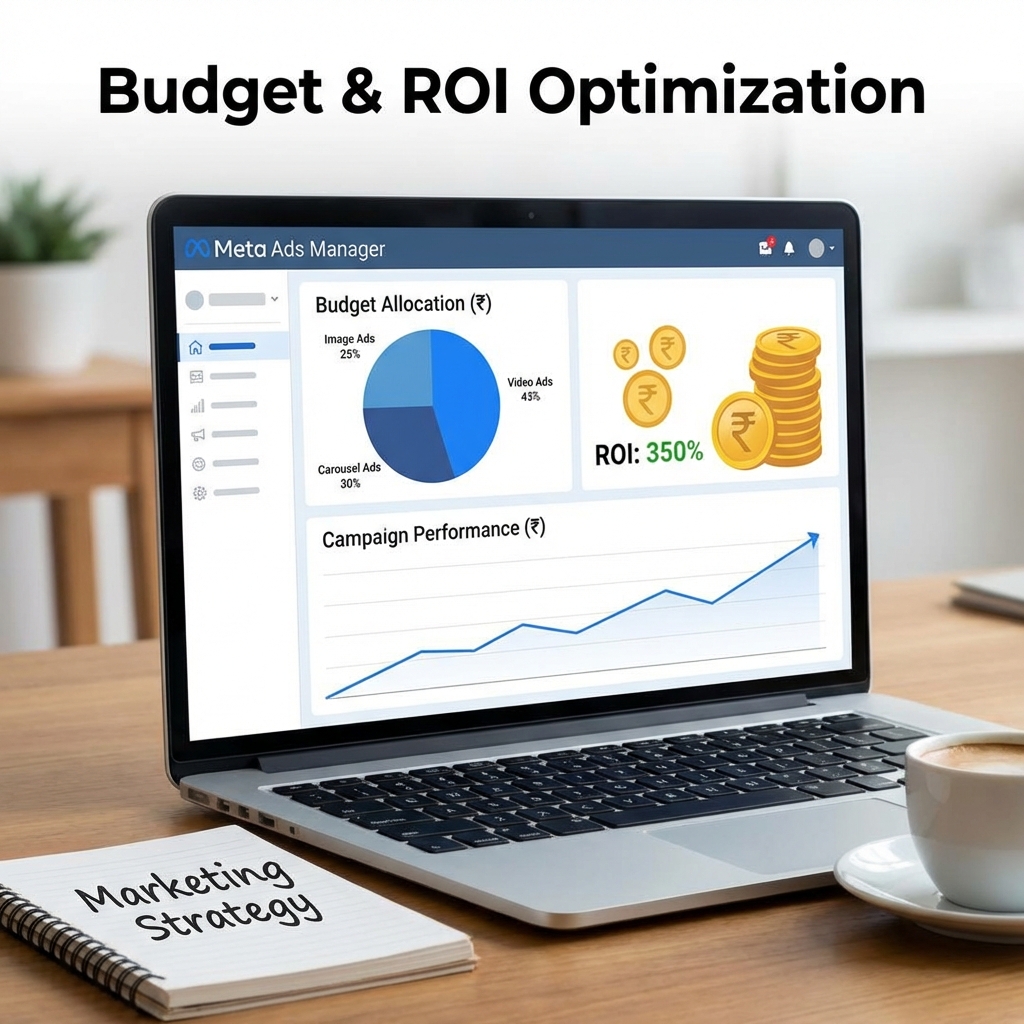
Budget Allocation
Minimum Per Variant: Rs 500 per day for 3-5 days Total Test Budget: Variants x Rs 2000-3000 each
Success Metrics
Thumbstop Rate: Video views at 3 seconds divided by impressions CTR: Click-through rate, aim for 1% plus on cold traffic CPC: Cost per click, benchmark against your industry CVR: Conversion rate on landing page
Step 10: Iterate Based on Data
Testing tells you what works. Iteration makes it work better.
Analyzing Test Results
Clear Winner: More than 30% difference in key metric with adequate spend. Scale it.
Marginal Winner: 10-30% difference. Test further to confirm.
No Clear Winner: Variables may be too similar. Test bolder differences.
Iteration Approaches
Winner Expansion: Take winning creative, create variations Element Extraction: Identify what specifically won (color, headline format, image type) and apply elsewhere Audience Variation: Test winning creative against different audiences
When to Refresh
Even winning creatives eventually fatigue. Watch for:
- CTR declining week over week
- CPM increasing without seasonal cause
- Frequency above 3-4 without retargeting
Refresh before performance drops significantly.
Common Mistakes to Avoid
Too Much Text on Image
Let the image do visual work. Save the details for copy.
Weak or Generic Hooks
"Check out our new collection" is not a hook. It is noise.
No Clear CTA
Tell people exactly what you want them to do next.
Poor Mobile Optimization
Test at actual mobile size. Many creatives fail this basic check.
Ignoring the Landing Page
The best creative fails if the landing page does not deliver what the ad promises.
Quick Reference Checklist
Before launching any Meta ad creative:
- [ ] Clear single message identified
- [ ] Scroll stopper element present
- [ ] Headline tested for impact
- [ ] Visual dimensions correct for placements
- [ ] Mobile readability verified
- [ ] Text overlay minimal and legible
- [ ] CTA clear and compelling
- [ ] Landing page matches ad promise
- [ ] Testing structure planned
- [ ] Budget allocated for adequate testing
Conclusion
Creating Meta ad creatives that convert is not magic. It is a systematic process of understanding the platform, developing strong messages, executing clean visuals, and testing relentlessly.
Follow this step-by-step framework. Document what works. Build your library of proven approaches.
The advertisers winning on Meta are not necessarily creative geniuses. They are systematic testers who find what works and scale it.
Start with this framework. Adapt it to your products and audience. Keep testing.
Need to produce Meta ad creatives quickly? Avocad generates professional, conversion-focused ads from product images in minutes. Try free at avocad.xyz.
— The Avocad Team